UNISONActive is an unofficial blog produced by UNISON activists for UNISON activists. Bringing news, briefings and events from a progressive left perspective.
Showing posts with label Referendum. Show all posts

Tuesday, 9 February 2016

UNISON must get anti-austerity, workers' rights and anti-TTIP message into EU vote debate

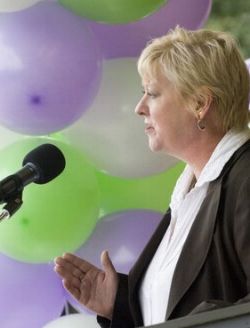
UNISON's Jane Carolan, speaking at today's Institute of Employment Rights Conference outlined the history of the union's position on the EU and the referendum debate ahead. This is the full text of her speech:-

'What happened in Greece was not 
an aberration from EU policies but a 
logical consequence of them.' 
Jane Carolan
"UNISON has no policy from NDC (National Conference) on the issue of leaving the EU. That may surprise some who have seen our regular opposition to policies on the European Union proposed through TUC Congress but there is no contradiction here. Quite simply UNISON’s democratically agreed policies have consistently been ultra-critical of the EU institutions practices and policies BUT not one of the motions that we have passed has actually gone on to propose that as a result the union should commit itself to backing an EU withdrawal.

This goes back to the first national delegate conference of the union. When Nalgo, NUPE and Cohse came together to form UNISON the Nalgo left could see from the proposed rule book that the new union was to be pro public service, anti-privatisation.

However there were a number of policies that had been hard fought for in the old Nalgo that needed to be reiterated in the new union. One was Palestine, where support for the self determination of the Palestinian People had been initially narrowly won in the 80s. A second was opposition to Trident replacement and a commitment defence diversification that remains UNISON policy to this day.

What can I say other than plus ca change…

And the final one was opposition to the Maastricht Treaty.

Monday, 1 December 2014

Giving Scotland a reason to back Labour for social justice

As the dust still swirls after the referendum, the challenge is to bring the focus back to the Scotland we want to see now. Of course the ‘neverendum’ campaign will continue but at some point we will have to address what we do with the powers we have now and will gain soon.

If, as advertised, it has all been about getting the powers to deliver on social justice, some have raised the question as to whether it really matters which party is in power in Scotland so long as it uses those powers to deliver.

Tuesday, 7 October 2014

Time to deliver for working people in Scotland

In the wake of last month's independence referendum, Lilian Macer, Convenor of UNISON in Scotland, has called for maximum unity in the struggle 'to create decent jobs, tackle low pay, end poverty - and deliver for working class people.' Speaking at a Morning Star labour movement conference last Saturday, Lilian said 'the outcome of the independence vote was about change — whether you were in the No or the Yes camp. People have demonstrated that they value public services, they don’t want more cuts, they reject privatisation and they want a fairer and more equal society.'
http://www.morningstaronline.co.uk/a-a3bb-Macer-Scots-must-put-referendum-aside-to-fight-poverty#.VDMA8VpwbIU

Monday, 6 October 2014

People's Assembly calls on Scotland to unite for more powers to defeat austerity

The People's Assembly has called for the energy both sides put into the referendum campaign to be channelled into ensuring that powers are delivered for Scotland that can be used to "reverse the austerity agenda".

The call was made as community activists, trade unions, trade union councils, politicians and other campaigning groups met for the People's Assembly Scotland AGM in Glasgow on Saturday 4 October 2014.

Tuesday, 23 September 2014

Democracy & Devolution - Rule P 1.3.6 the UNISON solution

In the aftermath of last week’s Scottish referendum the big political issue is the impact on the UK Parliament of greater devolved powers to Scotland, namely to what extent if any should Scottish MPs be excluded from voting at Westminster on say, matters affecting English public services. UNISON conference delegates might consider that this is one area where the union has been ahead of its time.   
    Over ten years ago UNISON NDC approved a report on bargaining and devolution which led to a simple rule change which dealt with the new reality of bargaining structures in devolved administrations and thus empowered the standing orders committee to make recommendations on restricting voting to delegates covered by specific negotiating machinery. Who are the modernisers and who are the dinosaurs?

Saturday, 20 September 2014

UNISON will continue to press for a just and fairer Scotland

UNISON's Scottish Secretary Mike Kirby has issued a post-referendum statement calling for the union to play its part in bringing Scotland together and campaigning for a just and fairer society. The first step is on 15 and 18 October when UNISON will join the STUC and Poverty Alliance conference and rally as part the Challenge Poverty Week.

Mike says UNISON will expect promises on powers to be honoured but warned about the debate getting bogged down in that alone: "...as we stated at the beginning of the referendum campaign the real question is how new or indeed existing powers are to be used for the benefit of working people." The full statement is below:

Friday, 19 September 2014

Now let the real fight back begin

Dateline Wednesday 17/09/2014

#indyref By now the result of the Scottish Referendum will be known. Some will be drunk with exhilaration; others will be drinking to forget it. Perhaps there is one starting point on which both sides can agree. Scottish politics needs to change, and politics per se with it.

Eighteen months or so of debate however have taken their toll, and one outcome is that bitter divisions that have been sown, a schism in Scottish society that could take years to heal. In particular an unthinking primitive nationalism has been aired and aired publicly This nationalism has labelled every dissenter from the “Yes” agenda as an English traitor or a lackey or pawn of the Westminster establishment to be ‘sent home’; or the epithet “a feartie” flung around to close discussion. It was sometimes said with a grin, in a pub, sometimes on the street with anger or menace.

It can be called playground politics but replaced rational debate on too many occasions, an anti English emotion directed against fellow Scots. Irrational prejudice is a form of racism. It is to be regretted that it formed part of the Independence debate. If divisions are to be healed, its invidious influence needs to be recognised and resisted.

UNISON campaigned for a “Just Scotland”. Whether we have “independence” whatever that means, as the SNP proposals are indeterminate as they are subject to negotiations; or whether we are to have “more and better devolution”, as latterly promised but for the moment equally vague, the aftermath of the debate around the “Independence” question points to a deeper consideration for those for whom the ideal of more just, more equal society is the goal. How do we get there?

What we have at the moment is the Austerity Agenda and a Scottish Parliament that has powers that it fails to use to tackle that agenda. We have a deeply unequal society where too many people simply exist rather than being able to live. We have poverty exacerbated by welfare cuts, and we have in work poverty where zero hours contracts and minimum wage jobs leaving workers on the breadline. We have a major failure of collective bargaining in the public sector that has led to substantial wage cuts. We have trade unions shackled by the most oppressive anti trade union legislation in Western Europe, whose diminished role is most clearly seen in the declining share of national income that goes to working people.

The greatest sufferers in this system are those children condemned to a cycle of poverty and lowered life expectations. These policies are not accidental. The current tax regime rewards the 1% at the top while cutting support for everyone else. In the last few years those at the top of the income and wealth ladder have been getting richer at a much faster pace than the population as a whole.

We no longer provide housing but have a property market designed to make those rich enough to own property a profit. Local authority public services are in danger of extinction - privatised and monetarised, forcing the poor to pay more for everything from care services to leisure and library fines, burials and cremations. Meanwhile a council tax freeze keeps Milngavie happy, but public sector workers are sold off to the lowest bidder.

The “NHS is tops” remains the top of all Scottish politicians slogans, but the integration of health and social care, between a public service and a largely privatised one, based on the exploitation of care workers, cannot be achieved on the combined resources of the two alone, not if the result is to be a quality service.

The Scottish energy industry has been nationalised – albeit by the French and the Spanish whose state companies enjoy the profits. Meanwhile companies like Ineos, English based and registered, take advantage of weak trade union protections and the recession to impose reductions to pay, pensions and terms and conditions on their workforce and to weaken the trade unions.

Private companies run our previously regulated or nationalised bus and rail systems, to their own advantage. Our justice system has privatised prisons and privatised security – at the moment. Voluntary sector provision exists on the precarious road to the cheapest price for every service – cheap that is for the commissioners but failing the client base and the service providers.

That is the agenda we will continue to face. If we believe our own propaganda, if we honestly believe in a just, more equal Scotland, we have a duty to stand up and campaign for change.

One thing that the referendum has proved is that there is appetite for changing Scotland. Both on the yes side, and the no side, there were those who shared rejection of the continuation of neo liberal politics, and a desire for change. But against that, there were also groups on both sides for whom lower taxes and the considerations of business and finance were paramount. Whoever has won the referendum, that is the dilemma that Scotland now faces. Does the appetite for equality and justice prevail or does business continue as usual?

If the future is to be one in which the possibility of change is to be realised, referendum yes or no positions must be forgotten and the agenda for change seized. For some party politics will dictate their attitude to whatever changes are proposed; my party right or wrong will trump radicalism. For others the radical agenda informs their party politics. That is the choice we now all face.

It is easy to say that the referendum campaign was about the rejection of English politicians. It was not. It showed a rejection of professional politicians, and for some of those advocating radical change that must include the party that in the most recent past has governed Scotland.

There have been a myriad of campaigns again austerity – mainly small and concentrating on one specific aspect, be it the bedroom tax, disability benefits, cuts campaigns, rarely looking at the bigger picture. In this UNISON needs to consider its own contribution. If a government department produces a paper advising on the length of Donald’s troosers, UNISON produces a briefing on it.

Across the output, there is an expectation that members can relate the briefing on the police cuts and the briefing on health integration and the briefing on housing finance into a coherent narrative - and that is a big ask. Did someone mention a wood and trees problem here? Comprehensive and integrated campaigning is needed to sustain momentum for change and to influence the direction whatever constitutional change is on the cards

Today the professional politicians of all shades and hues will issue their press statements and attempt to wrestle control of the agenda back into their hands. How change in Scotland is implemented, to ensure that it benefits the many not the few is now the task that needs to be faced. Whoever has won, we can give into rancour and recriminations, and rehash the same old arguments that have failed to convince one another for the past year.

Changing the agenda means changing the politics. That is the challenge.

Thursday, 11 September 2014

Think Before You Vote

With a week till the Scottish referendum vote, many with socialist tendencies have moved to a Yes position, on the basis that it will change the system. Sometimes however, romance and high hopes are not enough, and hoping and voting for constitutional change will not fundamentally alter the class nature of Scottish society. Moreover, it is impossible to divorce a Yes vote from the political context in which it would be delivered.
    Seamus Milne succinctly challenges those for whom a yes vote has become an end in itself here http://www.theguardian.com/commentisfree/2014/sep/11/salmond-scotland-no-escape-tory-britain   Read it and then consider the real consequences of this constitutional change.
WMCOS

Monday, 21 July 2014

Asking difficult referendum questions is essential

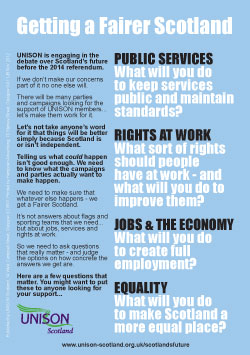
Despite some recent press coverage, UNISON's position on the referendum remains one of challenging both sides of the referendum debate on how their plans will create social justice, bring an end to austerity, poverty and health inequality. We want to know what they will do about building social cohesion, a more equal society and a world without nuclear weapons.

The referendum differs from the devolution campaign of the 1990s. There is no 'settled will of the Scottish people'. There is a divide. So, more important that taking positions of Yes or No, is pushing home the difficult questions for both camps and getting answers for our members.

Friday, 4 July 2014

Avoiding a stooshie becoming a stramash

From a Scottish Correspondent: There's a referendum going on in these parts and it's caused in UNISON what we call a stooshie.

A leading UNISON figure has come out for independence (big surprise) in 'a personal capacity' and 40 Scotland national conference goers (out of 281 - big news) have signed one of those petition things for independence - also in collective personal capacities (if that is not a contradiction).

All this has precipitated a message on the UNISON Scotland website reminding activists that:

Tuesday, 26 November 2013

Indy White Paper flags up need for cross border discussion

We have got the best part of a year to analyse the White Paper on Scottish Independence so any attempt to do the debate justice at this stage would be a bit previous. However, a Holyrood Magazine has thrown up some key cross border issues that will have to be adressed whatever the result.

Wednesday, 3 April 2013

Unions must focus on social justice in constitution debate

It is a bit of a leap to extrapolate that less intense opposition means Scottish trade unions are ‘shifting in favour of independence’. Nevertheless James Maxwell’s New Statesman article does, perhaps inadvertantly, put a finger on the difficulty trade unions face in getting their issues across when both referendum camps might be happier with a more simplistic debate.

Thursday, 24 January 2013

A Trade Union Yes to EU? Not at any Neo-Liberal price

Yesterday in his Bloomberg speech David Cameron set out a five point bottom line for renegotiation of the UK relationship with the EU, to be followed by an in-out referendum in 2018. Some senior Labour politicians argue that Cameron's stance is a distraction but in reality that's far from the case. His agenda for (acceleration of) neo liberal reform of the EU is a deadly serious threat to working people: http://www.number10.gov.uk/news/eu-speech-at-bloomberg/