UNISONActive is an unofficial blog produced by UNISON activists for UNISON activists. Bringing news, briefings and events from a progressive left perspective.
Showing posts with label Constitution. Show all posts

Saturday, 18 July 2015

Scotland after socialism?

Beneath the EU’s affront to democracy in Greece there is still the debate about whether Syriza reflects a shift to the left or whether it is just a singular reaction to a single issue which unites elements of left, right, middle and non-aligned. There is a mirror of this in Scotland as the debate around austerity always seems to end up as a debate about the constitution or national identity, as opposed to politics.
    The contradictions couldn't be more obvious. The words say: 'fight austerity, stop privatisation' and the actions bring privatisation upon privatisation and decimation of local government. Many are willing to excuse that as the result of failing to 'grasp independence' or because 'Labour did it before'. More worrying are those who actually support the service cuts, privatisations, tax freezes and business tax cuts as legitimate while still trumpeting an anti-austerity front.
   It makes for a difficult job for trade unions challenging these issues. Elements - sadly sometimes on the left - continue to try to characterise trade unions as part of the problem (the 'old order' or 'red tories') rather than the only realistic resistance we have to a mainstream political consensus that backs at least some level of austerity.
    In light of this, our attention was recently brought to a three paragraph blog from writer Ken Mcleod  which deserves wider distribution and will no doubt provoke some controversy but hopefully an interesting debate:

Tuesday, 23 September 2014

Democracy & Devolution - Rule P 1.3.6 the UNISON solution

In the aftermath of last week’s Scottish referendum the big political issue is the impact on the UK Parliament of greater devolved powers to Scotland, namely to what extent if any should Scottish MPs be excluded from voting at Westminster on say, matters affecting English public services. UNISON conference delegates might consider that this is one area where the union has been ahead of its time.   
    Over ten years ago UNISON NDC approved a report on bargaining and devolution which led to a simple rule change which dealt with the new reality of bargaining structures in devolved administrations and thus empowered the standing orders committee to make recommendations on restricting voting to delegates covered by specific negotiating machinery. Who are the modernisers and who are the dinosaurs?

Saturday, 20 September 2014

UNISON will continue to press for a just and fairer Scotland

UNISON's Scottish Secretary Mike Kirby has issued a post-referendum statement calling for the union to play its part in bringing Scotland together and campaigning for a just and fairer society. The first step is on 15 and 18 October when UNISON will join the STUC and Poverty Alliance conference and rally as part the Challenge Poverty Week.

Mike says UNISON will expect promises on powers to be honoured but warned about the debate getting bogged down in that alone: "...as we stated at the beginning of the referendum campaign the real question is how new or indeed existing powers are to be used for the benefit of working people." The full statement is below:

Friday, 19 September 2014

Now let the real fight back begin

Dateline Wednesday 17/09/2014

#indyref By now the result of the Scottish Referendum will be known. Some will be drunk with exhilaration; others will be drinking to forget it. Perhaps there is one starting point on which both sides can agree. Scottish politics needs to change, and politics per se with it.

Eighteen months or so of debate however have taken their toll, and one outcome is that bitter divisions that have been sown, a schism in Scottish society that could take years to heal. In particular an unthinking primitive nationalism has been aired and aired publicly This nationalism has labelled every dissenter from the “Yes” agenda as an English traitor or a lackey or pawn of the Westminster establishment to be ‘sent home’; or the epithet “a feartie” flung around to close discussion. It was sometimes said with a grin, in a pub, sometimes on the street with anger or menace.

It can be called playground politics but replaced rational debate on too many occasions, an anti English emotion directed against fellow Scots. Irrational prejudice is a form of racism. It is to be regretted that it formed part of the Independence debate. If divisions are to be healed, its invidious influence needs to be recognised and resisted.

UNISON campaigned for a “Just Scotland”. Whether we have “independence” whatever that means, as the SNP proposals are indeterminate as they are subject to negotiations; or whether we are to have “more and better devolution”, as latterly promised but for the moment equally vague, the aftermath of the debate around the “Independence” question points to a deeper consideration for those for whom the ideal of more just, more equal society is the goal. How do we get there?

What we have at the moment is the Austerity Agenda and a Scottish Parliament that has powers that it fails to use to tackle that agenda. We have a deeply unequal society where too many people simply exist rather than being able to live. We have poverty exacerbated by welfare cuts, and we have in work poverty where zero hours contracts and minimum wage jobs leaving workers on the breadline. We have a major failure of collective bargaining in the public sector that has led to substantial wage cuts. We have trade unions shackled by the most oppressive anti trade union legislation in Western Europe, whose diminished role is most clearly seen in the declining share of national income that goes to working people.

The greatest sufferers in this system are those children condemned to a cycle of poverty and lowered life expectations. These policies are not accidental. The current tax regime rewards the 1% at the top while cutting support for everyone else. In the last few years those at the top of the income and wealth ladder have been getting richer at a much faster pace than the population as a whole.

We no longer provide housing but have a property market designed to make those rich enough to own property a profit. Local authority public services are in danger of extinction - privatised and monetarised, forcing the poor to pay more for everything from care services to leisure and library fines, burials and cremations. Meanwhile a council tax freeze keeps Milngavie happy, but public sector workers are sold off to the lowest bidder.

The “NHS is tops” remains the top of all Scottish politicians slogans, but the integration of health and social care, between a public service and a largely privatised one, based on the exploitation of care workers, cannot be achieved on the combined resources of the two alone, not if the result is to be a quality service.

The Scottish energy industry has been nationalised – albeit by the French and the Spanish whose state companies enjoy the profits. Meanwhile companies like Ineos, English based and registered, take advantage of weak trade union protections and the recession to impose reductions to pay, pensions and terms and conditions on their workforce and to weaken the trade unions.

Private companies run our previously regulated or nationalised bus and rail systems, to their own advantage. Our justice system has privatised prisons and privatised security – at the moment. Voluntary sector provision exists on the precarious road to the cheapest price for every service – cheap that is for the commissioners but failing the client base and the service providers.

That is the agenda we will continue to face. If we believe our own propaganda, if we honestly believe in a just, more equal Scotland, we have a duty to stand up and campaign for change.

One thing that the referendum has proved is that there is appetite for changing Scotland. Both on the yes side, and the no side, there were those who shared rejection of the continuation of neo liberal politics, and a desire for change. But against that, there were also groups on both sides for whom lower taxes and the considerations of business and finance were paramount. Whoever has won the referendum, that is the dilemma that Scotland now faces. Does the appetite for equality and justice prevail or does business continue as usual?

If the future is to be one in which the possibility of change is to be realised, referendum yes or no positions must be forgotten and the agenda for change seized. For some party politics will dictate their attitude to whatever changes are proposed; my party right or wrong will trump radicalism. For others the radical agenda informs their party politics. That is the choice we now all face.

It is easy to say that the referendum campaign was about the rejection of English politicians. It was not. It showed a rejection of professional politicians, and for some of those advocating radical change that must include the party that in the most recent past has governed Scotland.

There have been a myriad of campaigns again austerity – mainly small and concentrating on one specific aspect, be it the bedroom tax, disability benefits, cuts campaigns, rarely looking at the bigger picture. In this UNISON needs to consider its own contribution. If a government department produces a paper advising on the length of Donald’s troosers, UNISON produces a briefing on it.

Across the output, there is an expectation that members can relate the briefing on the police cuts and the briefing on health integration and the briefing on housing finance into a coherent narrative - and that is a big ask. Did someone mention a wood and trees problem here? Comprehensive and integrated campaigning is needed to sustain momentum for change and to influence the direction whatever constitutional change is on the cards

Today the professional politicians of all shades and hues will issue their press statements and attempt to wrestle control of the agenda back into their hands. How change in Scotland is implemented, to ensure that it benefits the many not the few is now the task that needs to be faced. Whoever has won, we can give into rancour and recriminations, and rehash the same old arguments that have failed to convince one another for the past year.

Changing the agenda means changing the politics. That is the challenge.

Thursday, 11 September 2014

Think Before You Vote

With a week till the Scottish referendum vote, many with socialist tendencies have moved to a Yes position, on the basis that it will change the system. Sometimes however, romance and high hopes are not enough, and hoping and voting for constitutional change will not fundamentally alter the class nature of Scottish society. Moreover, it is impossible to divorce a Yes vote from the political context in which it would be delivered.
    Seamus Milne succinctly challenges those for whom a yes vote has become an end in itself here http://www.theguardian.com/commentisfree/2014/sep/11/salmond-scotland-no-escape-tory-britain   Read it and then consider the real consequences of this constitutional change.
WMCOS

Monday, 21 July 2014

Asking difficult referendum questions is essential

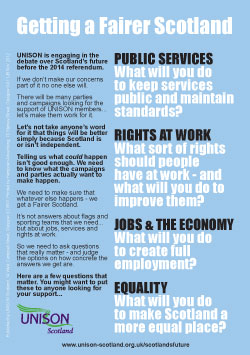
Despite some recent press coverage, UNISON's position on the referendum remains one of challenging both sides of the referendum debate on how their plans will create social justice, bring an end to austerity, poverty and health inequality. We want to know what they will do about building social cohesion, a more equal society and a world without nuclear weapons.

The referendum differs from the devolution campaign of the 1990s. There is no 'settled will of the Scottish people'. There is a divide. So, more important that taking positions of Yes or No, is pushing home the difficult questions for both camps and getting answers for our members.

Saturday, 22 February 2014

STUC independence study everyone should read

The Herald newspaper has, well, heralded the STUC's 'A Just Scotland' comprehensive analysis of the key referendum issues. http://www.heraldscotland.com/comment/columnists/union-study-on-union-everyone-should-read.23486896
    "It bypasses the entrenched positions, debunks the overblown rhetoric and provides a realistic assessment of various possible outcomes following a Yes or No vote", writes political editor Magnus Gardham. "Refreshingly, it comes at the whole question of independence with a genuinely open mind."
   On social justice, currency, Europe and economic policy, the Herald says the report "doesn't make entirely happy reading for either side. That alone should be enough to commend it to all open-minded, undecided or downright confused voters."
See the full report at http://www.stuc.org.uk/news/1053/stuc-publish-second-just-scotland-report

Thursday, 20 February 2014

Where are the unions in the independence debate?

As the Scottish TUC publishes its second 'A Just Scotland' report today, the Scotsman newspaper queries why both sides of the independence debate seem so far to have failed to woo the unions on their social justice agenda. http://www.scotsman.com/news/andrew-whitaker-the-referendum-and-the-union-vote-1-3312820
   While it is the case that public pronouncements from both camps have been thin on the ground, there is no doubt that there is behind the scenes nudging and winking about how each settlement would best serve workers' interests. Nevertheless, the article is right in its main thrust that most of the effort seems to be going into getting big business and celebrities on board.

Tuesday, 3 December 2013

Scotland’s Future - Can We Have a Rational Debate?

“Society cannot share a common communication system so long as it is split into warring factions.” Bertholt Brecht
Even the most southerly reader of UNISONActive can hardly have escaped the recent pronouncements from the Scottish Government with regard to independence.

Tuesday, 26 November 2013

Indy White Paper flags up need for cross border discussion

We have got the best part of a year to analyse the White Paper on Scottish Independence so any attempt to do the debate justice at this stage would be a bit previous. However, a Holyrood Magazine has thrown up some key cross border issues that will have to be adressed whatever the result.

Wednesday, 12 June 2013

Unions and Scottish Independence

'With over 650,000 members in Scotland, the unions may become an important battleground for the Yes and No camps. What will make this more interesting is the unions will not be passive, for as the referendum nears, they are likely to put conditions on the price for any support they give to either side'. Gregor Gall analyses at the constitution debate in Scotland's unions. http://www.scotsman.com/the-scotsman/opinion/comment/gregor-gall-you-won-t-get-me-as-part-of-the-union-1-2961519 - See more on the independence debate at http://unisonactive.blogspot.co.uk/search/label/Independence

Wednesday, 3 April 2013

Unions must focus on social justice in constitution debate

It is a bit of a leap to extrapolate that less intense opposition means Scottish trade unions are ‘shifting in favour of independence’. Nevertheless James Maxwell’s New Statesman article does, perhaps inadvertantly, put a finger on the difficulty trade unions face in getting their issues across when both referendum camps might be happier with a more simplistic debate.

Monday, 25 February 2013

The big issues for UNISON members in Scotland

'How are we going to achieve a fairer, more equal society? Can you achieve that with independence, through the status quo or with more devolution? In terms of local government, it is really important that people start talking about what kind of local government we want.' UNISON Scotland's deputy regional convenor Stephen Smellie comments on the constitutional debate and other topics in a personal profile published by Scottish political journal Holyrood: http://www.holyrood.com/2013/02/for-the-people-unison-scotland-vice-convener-stephen-smellie/

Wednesday, 3 October 2012

Social justice key to constitution debate

UNISON's Scottish Council discussed Scotland's future on Saturday. The debate was teed up by Scottish Secretary Mike Kirby's Article in the Morning Star. UNISON has to focus on the vision of social justice we want for our members and without that the whole debate will be a missed opportunity. He makes the eminently sensible point that rushing to endorse either pro or anti - independence camps will do the trade unions' vision no favours.
http://www.morningstaronline.co.uk/news/content/view/full/124425

Monday, 24 September 2012

Scots Wha Hae?

In the debate over Scotland’s future all contributions are welcome, as those of us ambivalent about independence are willing to be persuaded. So articles in the Morning Star on the subject offering a socialist perspective have a crucial role. Thus last week the Star published “The Scottish Quest for Freedom” by Colin Fox Leader of the Scottish Socialist party http://www.morningstaronline.co.uk/news/content/view/full/124098

Thursday, 6 September 2012

Red Paper alternative- independence or people power

As the SNP again launches its independence campaign with no more detail than the last few launches, a new left campaign in Scotland rejects the SNP’s version of independence while also rejecting the policies of those content with the status quo. "The referendum offers an opportunity to ask more far reaching questions about the future of Scotland and what type of society we want to live in", says a  Red Paper Collective pamphlet.
..Redpaper.net is a group of trade union, academic and left activists looking at the national question in Scotland from a class perspective.

Sunday, 29 April 2012

The Social Europe agenda has been parked long ago

Mike Kirby, UNISON’s Scottish Secretary, reflects on the political situation in a Morning Star interview to mark the end of his term of office as President of the Scottish TUC: http://www.morningstaronline.co.uk/news/
content/view/full/118354

Wednesday, 25 April 2012

Constitutional debate must look beyond independence

#STUC12 In a surprisingly low key but deeply significant debate, the Scottish TUC has launched a major engagement with members and the public about the future of Scotland. That constitutional debate "should not be about what powers politicians want, but about what they want to do with those powers”, UNISON’s Stephen Smellie told Congress this morning.